

An unconventional cheat sheet to the subtle patterns that predict who will truly succeed and scale with your organization.
About a decade ago, I helped an early-stage biopharma company through a period of rapid scaling. The mandate was simple: hire the best people. We targeted candidates from brand-name companies with polish, charisma, and pedigree, the “obvious” choices, and hired them by the dozens. At the time, it felt like a no-brainer.
Within two years, half were gone. Turnover was high, morale low, and the hires we were most confident about were the first to struggle. It shouldn’t have been surprising. In Leadership IQ’s study of more than 20,000 hires, 46% washed out within eighteen months; 89% of those failures were traced to attitude and temperament, not a missing skill. These candidates looked strongest on paper but were the least prepared for what the role actually demanded: grit, comfort with ambiguity, and the humility required to start over just when you thought you had arrived.
We should have focused on the quieter, harder-to-read candidates whose strengths were more subtle. Decades of research on unstructured, gut-feel interviews correlate results at roughly 0.2 to 0.4, not much better than chance.2
This piece is about those signals: how to spot them, how to test them, and how to better discern between someone who interviews well and someone who is more likely to exceed expectations.
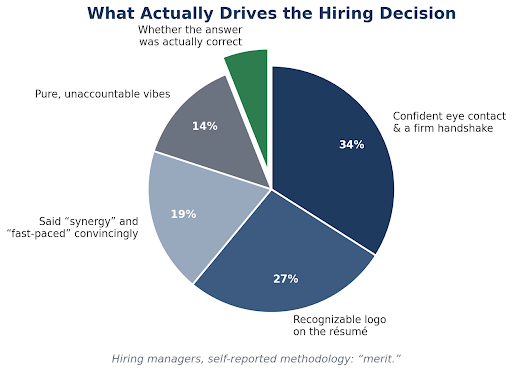
The wrong things, visualized. Allocations approximate; the sliver is generous.
Lou Adler’s performance-based hiring framework draws a hard line between people who are genuinely competent and motivated versus those who merely appear to be. His blunt conclusion explains that the worst hires are usually the ones who made the best presentations.3 In biopharma, that’s an expensive problem. The U.S. Department of Labor estimates that a single bad hire costs at least 30% of that person’s first-year earnings, and SHRM’s figures estimate almost five times the annual salary for senior roles.4
Drucker said the most important decisions a manager makes are people decisions.5 Welch spent more than half his time as GE’s CEO on people.6 Neither of them was talking about finding candidates who interview well.
Adler captures the whole trap in a single grid. One axis is how well a candidate performs in the interview; the other is how well they perform once hired. Two of the four outcomes are easy to live with. The strong interviewer who turns out strong (box I), and the weak interviewer who would have been weak anyway (box IV). The other two are where the money goes. The candidate who dazzles and then underdelivers (box II), and the one who interviews poorly but would have excelled (box III). Those are the boxes almost no one catches in the room.
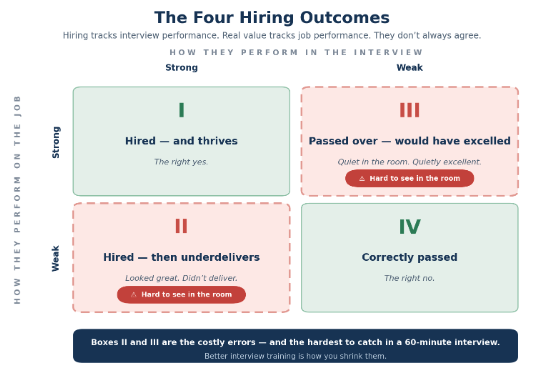
Adapted from Lou Adler, Hire With Your Head, Figure 1.2
What “Gut Feel” Actually Is
It is worth being honest about what gut feel really is, because often enough, it’s quietly making the final decision. The real question in any interview is brutally hard. Will this person perform, adapt, and still be here and worth trusting in two years? Nobody can answer that in an hour. So, the mind does what Daniel Kahneman called ‘attribute substitution’; it swaps the impossible question for an easy one. Do I like them? Do they feel impressive? Do they feel like one of us? Gut feel is the confident answer to the easy question, wearing the clothes of the hard one.
Underneath much of hiring is a loyalty calculation that most people do not even realize they are making. A senior hire is a vulnerability bet, since you’re handing a near-stranger real influence over your roadmap, your culture, and your reputation. The brain naturally treats the unfamiliar as risk, so people fall back on ancient trust cues. Including warmth, social proof, familiarity, the feeling that someone is “one of us.” The problem is that these are signals of tribal alignment, not loyalty, and they are nearly impossible to verify in an interview room. Worse still, the candidate most skilled at performing allegiance is often the least likely to deliver it, while the blunt outsider willing to say something uncomfortable may be exactly the person who will defend you when it matters.
The trap is predictable: we mistake fluency for competence. A smooth story and confident delivery feel true whether they are or not. One vivid trait or a firm handshake throws a halo over everything else. We decide in the first thirty seconds and spend the rest of the interview collecting evidence for a verdict we have already reached, consistently preferring people who remind us of ourselves.2
Here’s the part that should worry anyone who hires primarily on instinct. Intuition only improves when it receives fast, accurate feedback. That works in chess, on a trading floor, or in an emergency room, where decisions are constantly tested against reality. Hiring is nothing like that. The feedback arrives months later, tangled in organizational politics, onboarding quality, market conditions, and team dynamics. Worse, you never get to see the careers of the people you rejected. The one environment where intuition struggles to calibrate is the one where people trust it most. This is not an argument against instinct; the loyalty question is real and worth answering. It is an argument for answering it deliberately, with behavior, references, and observable work, instead of outsourcing it to a feeling. In head-to-head studies, structured interviews predict job performance roughly twice as well as unstructured, “gut feel” conversations, with correlations in the 0.4–0.5 range versus the low 0.2s for intuition-driven hiring.
The following signals appear consistently, regardless of profession or level. They are most critical in smaller companies with less room for error, and they are the ones I have come to trust most.
1. Calm, Understated Confidence
Top performers rarely feel the need to convince you they are exceptional. There is a calmness to them that shows up physically as much as in what they say. They are not auditioning. They are having a conversation.
They listen. They pause before answering hard questions. They take accountability without being prompted. They do not oversell.
The clearest signal I have found is that strong candidates can describe their own weaknesses more specifically than average candidates can describe their strengths. That is not modesty. It is self-awareness, which, in my experience, is one of the rarest things in hiring anywhere.
Test it simply: Ask a hard question and then go quiet. Do not rescue them, even if it feels awkward. The candidate who sits with that silence, thinks, and answers honestly is telling you something real. The one who immediately fills the air with polished noise is also telling you something.
2. The Name Game: It’s Not Who You Know. It’s Who Knows You.
A certain kind of candidate threads important names through every answer. Including the celebrated founder they “worked closely with,” the marquee investor on speed dial, the luminaries they expect will impress you by association. It is a tell, just not the one they intend. Borrowed prestige is what people reach for when the real signal is thin. And the real signal is not who they claim to know; it’s who will vouch for them.
High performers leave a wake. When you reference-check a strong candidate in this category, former colleagues tend to volunteer stories without much prompting. They recall specific moments and specific contributions. They say things like, “That person made everyone around them sharper,” or, “I would work with them again without a second thought.” That is reputation, and it has very little to do with the logo on someone’s résumé.
The candidate who knows everyone but is not particularly known by anyone is a distinct profile. They name-drop fluently. Their references are carefully curated and tend to be vague in ways that are hard to pin down but easy to feel.
Observe whether they answer with confidence or equivocation. Then verify if those people truly would.
3. Velocity Over Altitude
Look at the promotion track record: how far someone has climbed, the number of real scope expansions, and their starting point. A steep ascent from a modest start is often more telling than a senior title someone settled into and never left. How far has this person traveled relative to where they began?
Others started halfway up the ladder, buoyed by a well-connected family, a lucky first break, or the right city. Two people can reach the same title, but the one who traveled further usually brings more range and more grit.
A Director at a scrappy startup may have more real leadership range than a VP who has spent a decade inside a well-resourced machine. Adler’s framework pushes on this directly: Is this person motivated to do the actual work, or motivated to hold a title? Those turn out to be very different people once they are on the job.
Drucker’s point is worth keeping in mind here: you are not looking for someone without weaknesses. You are looking for someone whose specific strengths match what you need done.
Before the interview, map their career jumps and look for the leaps in scope and context. Then ask them to walk you through each transition. People with real momentum know exactly why they made each move. Candidates who drift usually can’t tell you.
4. The Interview Athlete
Some candidates are simply excellent at interviewing. They come prepared with polished answers, well-rehearsed stories, and a strong presence. I call them Interview Athletes, and they are a real hazard in hiring because they are so easy to like. The “Interview Athlete” who wows all the interviewers often presents as a no-brainer Type I on the Adler Grid, when in reality they are a Type II, highly skilled at projecting competence and confidence but poorly aligned with the actual behavioral demands of the role. The maddening part is that, according to the same Leadership IQ research, 82% of managers later admitted they noticed warning signs during the interview and talked themselves out of them.1
It helps to name the trap plainly. Some people are simply born likable, with good looks, easy charm, and a real gift for persuasion. Those are advantages in a sales meeting and hazards in an interview, because they make you want to hire someone before you have seen any evidence that you should. Likability is pleasant. It is not a qualification and, on its own, predicts almost nothing about their work.
A useful correction is what I think of as the Transcript Test. Strip away the charisma and just read the logic. Does the answer hold up on its own, or was the polish carrying most of the weight? Welch wanted people with genuine energy who could energize others, not people who performed energy. The difference is visible if you are paying attention.
Partway through the interview, ask something genuinely off-script, not a trick question, just something outside the prep material. Interview Athletes often lose their footing when the rehearsed answers run out; the real performer tends to get more interesting. In biopharma, this is especially costly because senior hire stakes are high and the window for correction is short. The Transcript Test is your friend here: Read the logic and ignore the energy. If the answer looks thin on paper, it is.
5. Behavioral Congruence
The clearest signal in an interview is not confidence, charisma, or executive presence. It is how someone talks about failure. Ask a candidate about a bad hire, a collapsed initiative, a decision they regret, or a project that went sideways, then pay close attention to what happens next. The strongest people tend to answer plainly. They stay composed. They acknowledge their role in the outcome without theatrics or self-protection. The weaker ones often do something subtler; they narrate failure as though it simply drifted into their lives from the outside world. The market shifted. Leadership changed. The program was shut down. The timeline became unrealistic.
Listen carefully to the grammar of accountability. “The program was shut down” is a very different sentence from “we made a decision that did not work.” One describes an unfortunate event. The other describes ownership. And ownership, more than polish, is usually what separates people who grow from adversity from those who merely survive it.
This is where so-called executive presence becomes useful, not as a measure of charisma, confidence, or eye contact, but as a measure of congruence. Do someone’s words, affect, and demeanor align under pressure, or do they subtly fracture when responsibility enters the conversation? A caution: Body language is noisy and easy to misread. Culture, age, personality, gender, and nerves all distort presentation. Plenty of deeply competent people appear awkward or restrained in high-stakes interviews. What matters is not polish; it is whether accountability feels instinctive or rehearsed.
6. Intellectual Empathy
The ability to explain complexity simply is, in my view, one of the most underrated leadership skills. I think of it as intellectual empathy, understanding what another person does not yet know and adjusting accordingly, without talking down to them and without losing the substance.
A straightforward screen is to ask candidates to explain their work to a scientist, then to an investor, then to a ten-year-old. Strong communicators shift vocabulary and framing without being asked. Candidates who give you essentially the same answer regardless of the audience will struggle in cross-functional environments. And in any company building something complex, cross-functional is not just a buzzword. It is Monday morning.
You can also pick this up in real time. Watch how they talk about their own field during the interview. Are they literally explaining something to you, or are they signaling that they know things? One approach builds shared understanding; the other is just performance.
7. Resilience (The Real Kind)
Biotech is fundamentally an industry of disappointment management. Trials fail, and they fail at scale. Only about 7% of drugs that enter Phase I ever reach approval, down from roughly 10% a decade ago, with most programs dying at the Phase II hurdle.7 Funding disappears. Programs get cut. Good people get laid off through no fault of their own; biopharma logged more than 60 layoff rounds in the first quarter of 2025 alone.⁸ If any of that surprises your candidate, they are going to have a rough few years.
Real resilience is not positivity theater. It is the ability to retain agency after a setback. The strongest candidates I have met usually carry scars and can describe them plainly, without self-pity or retrofitting the experience into some inspirational narrative they were supposedly destined to learn from. They got knocked around, adapted, and kept moving.
Adler’s observation holds here: genuine top performers have almost always absorbed a meaningful professional failure. An entirely unbroken track record is often less reassuring than it appears. People who have never failed are frequently people who have never been tested at the edge of their abilities.
Ask candidates about a deeply invested program that failed. Listen for an honest analysis of the situation and concrete changes they would make. Beware the impulse to transform the failure into a hidden victory before you can register the loss itself. Truly resilient people do not need to immediately redeem every setback; they acknowledge disappointment without surrendering agency to it.
8. Institutional Generosity
The best people do not spend the interview taking credit for everything. Average candidates lean hard on “I,” claim every win, and find quiet ways to diminish colleagues who are not in the room to push back.
Listen for self-importance, which is quieter than arrogance and easier to miss. Watch for the candidate who claims every victory and implies a catastrophe would have followed without them. A little is ordinary interview inflation, but a lot is a tell. Someone who needs to be the indispensable hero may struggle to operate as part of a collaborative team, a non-negotiable requirement in a small company. Strong candidates describe what the team accomplished and are specific about their own role. They also rarely talk toxically about former employers; bitterness travels well.
Pay attention to pronoun patterns. A candidate who defaults to “we” and switches to “I” only when you ask specifically about their contribution is wired differently from one who leads every answer with “I” and treats the team as a backdrop. In a small company where everyone has to pull for each other, that distinction is paramount.
9. Adaptability
In biotech, adaptability isn’t a soft skill; it’s a necessity for survival. Holding a fifteen-person discovery company together is completely different from commercializing a Phase III asset. Some truly brilliant scientists fall apart the moment organizational complexity and ambiguity show up. Others evolve. You want to know which type you are looking at.
One of the most common and painful outcomes I see is someone who was exactly the right hire for the company that existed, but not for the one it became six months later.
Ask them about a time their role shifted significantly under them, through a reorg, a pivot, a funding change, whatever. The adaptable candidate has a real story and can describe the discomfort with details that ring true. The rigid candidate will tell you how they managed the transition from a safe distance rather than actively adapting through it.
Better yet, don’t just ask, but engineer a small curveball and watch. Swap out an expected interviewer, move the time, or change the scope of their presentation an hour beforehand. The point is not to rattle them; it is to see the real thing instead of the rehearsed answer. The adaptable candidate rolls with it, sometimes even enjoys it. The rigid one is visibly thrown, and the brittle one gets short-tempered or irritated, which tells you, for free, exactly how the first reorg will go.
10. Rate of Learning
Most hiring managers ask whether someone can do the job today. The better question is how fast they can master new things.
The clearest observable signal is candidates who correct themselves mid-sentence. Not because they are nervous, but because they are actually thinking, and the truth matters more to them than sounding polished. That orientation, truth over ego protection, is hard to find.
Welch called it the ability to face reality as it is rather than as you wish it were. Drucker called it intellectual integrity. I just call it the thing I’m always looking for.
A clean way to test it is to send a short piece of material a day ahead, a one-page memo, a small dataset, or a thorny tradeoff, and spend part of the interview discussing it.
One caution, though, is that it’s possible to over-select for raw learning speed and end up with a roster of brilliant, fast-learning people who won’t tell each other the truth or stay when it gets hard. Rate of learning is a multiplier, not a substitute for integrity or generosity. The quick study who isn’t also a decent teammate already has one foot out the door.
A clean way to test it is to send a short piece of material the candidate has not seen, a one-page memo, a small dataset, a thorny tradeoff, a day ahead, and spend part of the interview discussing it. You are not checking whether they found the right answer. You are watching how quickly they build a real model of something new, and whether they update it out loud when you push.
11. The Résumé Trap
A confession to end on: The costliest hiring mistake usually happens before the interview stage. It happens at the resume screen, where someone with four hundred applications and an afternoon is told, sensibly enough, to filter out anything iffy. This includes short tenures, gaps, a nonlinear path, and a title that doesn’t match the level. The heuristic is sensible, and on average it works, but ‘average’ is doing a lot of quiet damage. The same filter that screens out the bad fits also screens out a particular kind of superstar before a single human has spoken to them.
These people never even make it onto Adler’s grid. Box III is the candidate who interviews poorly and gets passed over. This is worse, the one who would have excelled and never gotten the interview, because a keyword filter or an overloaded screener decided their paper did not clear the bar. You don’t get a false negative you can learn from, just a blank space where a great hire should have been.
The examples are humbling once you start looking. Katalin Karikó was demoted four times at the University of Pennsylvania, had her foundational mRNA papers rejected by Nature and Science, lost funding, and was eventually pushed out. The same line of work won the 2023 Nobel Prize and underpins the mRNA vaccines.9 Jan Koum and Brian Acton were both turned down for jobs at Facebook and Twitter before going on to build WhatsApp, which Facebook later bought for nineteen billion dollars.10 On paper, at the moment of the decision, not one of them looked like an obvious yes.
You cannot interview everyone, and the screen must exist. But you can widen it on purpose. Pull a handful of the iffy-on-paper candidates into the room anyway, especially those whose ‘oddness’ reflects the signals discussed here: a non-linear path, a short stint with a real story, or a pedigree that doesn’t fit the obvious slot.
The Pattern, Revisited
Hiring humbles everyone, but patterns do emerge: the flashy hire often disappoints, while the quieter candidate with the nonlinear path becomes the person everyone later insists was obviously exceptional.
They were not obvious. That’s exactly the point.
As Adler argues in his performance framework, do not make long-term decisions on short-term information. The interview is built to surface short-term information, polish, confidence, and presence. What really predicts whether someone lands in box I or box II takes longer to see, which is exactly why so many capable teams get fooled. The fix is not a better gut; it’s a better process, defined by three moves:
- Build the interview around the signals that predict performance, not the ones that predict likeability.
- Require the panel to defend its reading against the evidence rather than the energy in the room.
- Train every interviewer to recognize boxes II and III, because the hires that cost you the most are the ones no one was taught to see.
Do that, and the polished candidate who would have flamed out stops getting the offer, and the quiet one who was always going to be your best hire stops slipping away. The work is not a better feeling about people, but a better way of seeing them, including the ones your own résumé filter told you to skip.
As the founder of Sci.bio, my perspective is grounded in two decades and hundreds of biopharma searches: the best hires are seldom the most polished, obvious, or conventional candidates on paper. I’ve learned that human potential rarely follows a linear path, and that the quietest people often create the greatest long-term impact.
References
- Leadership IQ (Mark Murphy), “Why New Hires Fail” / “Hiring for Attitude” study of more than 20,000 hires. leadershipiq.com
- Schmidt, F. L., & Hunter, J. E. (1998), “The Validity and Utility of Selection Methods in Personnel Psychology,” Psychological Bulletin; see also Sackett et al. (2022), Journal of Applied Psychology. summary (PDF)
- Adler, L., Hire With Your Head (Wiley) and the Performance-Based Hiring framework. performancebasedhiring.com
- Cost of a bad hire: U.S. Department of Labor (≥ 30% of first-year earnings) and SHRM replacement-cost estimates. talogy.com
- Drucker, P. F. (1985), “How to Make People Decisions,” Harvard Business Review. hbr.org
- Welch, J., on the share of his time spent developing people (Winning; GE-era interviews). entrepreneur.com
- BIO, Informa Pharma Intelligence & QLS Advisors, “Clinical Development Success Rates” (2021; 2024 update). pharmaphorum.com
- Fierce Biotech, Layoff Tracker, and Q1 2025 layoff analysis. fiercebiotech.com
- Karikó, K., on her demotions and rejected mRNA papers at the University of Pennsylvania; 2023 Nobel Prize in Physiology or Medicine (with Drew Weissman). cnbc.com
- Acton, B. & Koum, J., rejected for jobs at Facebook and Twitter before founding WhatsApp (acquired by Facebook for $19 billion, 2014). inc.com